Turn equations, sensors and embedded hardware into a system you can test.
Paid, bounded engineering across three lanes: AI infrastructure on hardware you own, robotics and flight control from equations to firmware, and datasets, technical content, and websites through the Antsand pipeline.
Every engagement begins with one bounded question and ends with code, models, tests, documentation, and explicit limitations.
Choose the lane that matches the problem
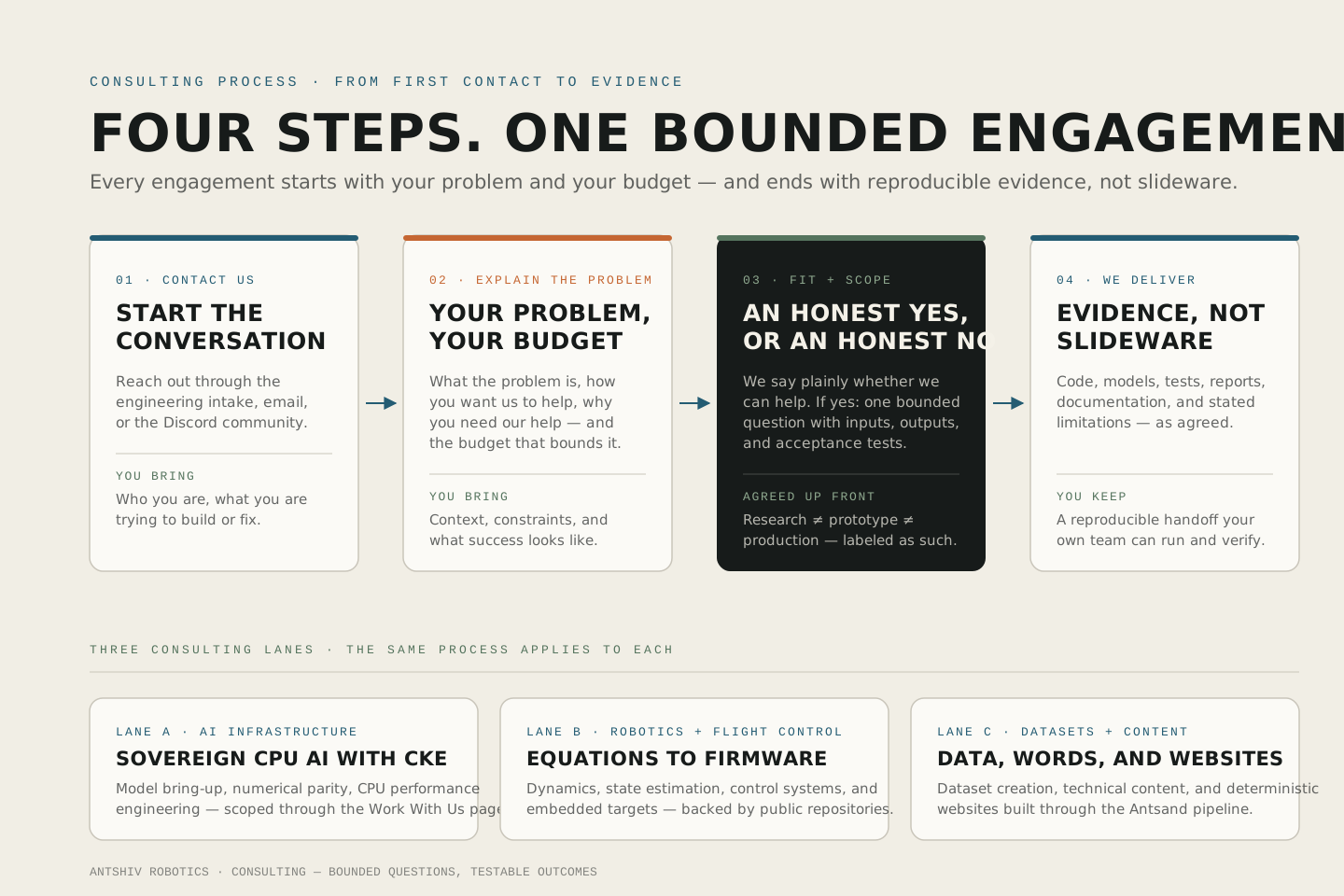
The same bounded process applies to every lane — contact us, explain the problem and the budget, we scope honestly together, and we deliver evidence.
Sovereign CPU AI
Model bring-up, numerical-parity investigation, and CPU performance engineering with C-Kernel-Engine on clusters you own — Xeon, EPYC, or ARM.
Equations to firmware
Flight dynamics, state estimation, control systems, and embedded implementation — the same work published in our open flight-control repositories, from quaternion mathematics to test rigs.
Data, words, and websites
Dataset creation and curriculum design, technical content, and deterministic websites built through the Antsand pipeline.
How a consulting engagement works
Four steps: contact us, explain your problem and your budget, we decide honestly whether and how we can help, and we deliver reproducible evidence. The diagram is the contract.
Specific problems, testable outcomes
Each engagement is qualified against available hardware, source access, reference behavior, budget, and the evidence required to call it complete.
Equations before airframes
Rigid-body dynamics, rotor and actuator models, six-degree-of-freedom simulation, coordinate frames, and quaternion mathematics.
Sensors into state
IMU processing, complementary and Kalman-family filters, attitude, velocity, and position estimation, and noise, bias, and uncertainty modeling.
Stable by construction
PID and cascaded controllers, stability and response analysis, controller tuning, simulation before hardware, and explicit timing and safety boundaries.
Deterministic firmware
C/C++ firmware for Linux and microcontroller targets, sensor and actuator interfaces, deterministic execution, and profiling, memory, and timing investigation.
Evidence before claims
Numerical reference models, software-in-the-loop, hardware-in-the-loop, thrust stands and physical test rigs, and reproducible reports with evidence boundaries.
Evidence-gated boundaries
Production autonomous flight, safety certification, and proven multi-node CKE scaling are not offered as established capabilities today.
What a bounded engagement produces
Running AI on owned CPU infrastructure rather than an embedded control problem? That is the Work With Us path.
Bounded question
Begin with one bounded question — a behavior, limitation, model, or platform — with scope, reference, hardware, and acceptance criteria.
Inputs, outputs, acceptance
Define inputs, outputs, and acceptance tests before work begins, so complete has a measurable meaning.
Research ≠ prototype ≠ production
Research findings, prototypes, and production claims are separated and labeled — never blended into one promise.
Handoff
Code, models, tests, documentation, and limitations delivered as agreed — reproducible by your team.
Antshiv Robotics builds intelligent systems we can understand all the way down, from mathematical kernels and CPU runtimes to simulation, flight control, and autonomous machines.